






Although this is not strictly a jungle story (or is it?), it still bears the flavour of early 1960s rural Uttar Pradesh, which were exciting times in the region.
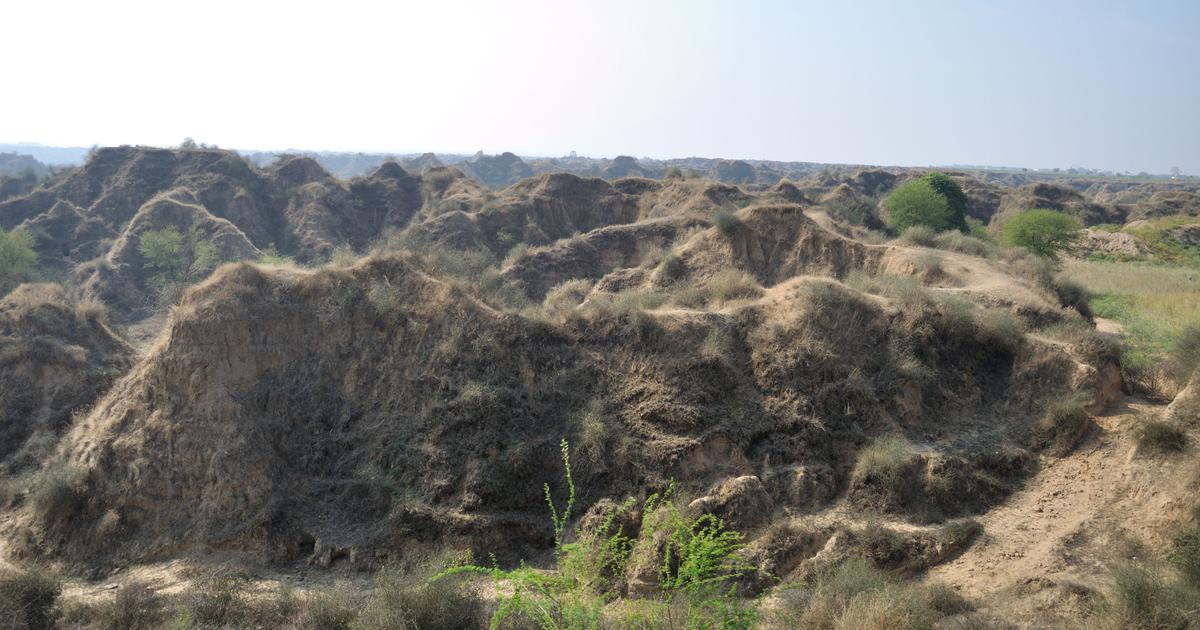
In mid-1963, as a Joint Magistrate posted in Agra district, I was given charge of the Bah-Fatehabad sub-division, situated to the west of the district along the Chambal River. It was the most backward area of the district, largely comprising the deadly gullies and ravines of the Chambal and known for the fearsome dacoits who lived there. The ravines were so deep and numerous that a whole army could hide in one without anyone in the next ravine being aware of it. This was the reason that it was a favourite hideout of the dacoit gangs, who would elude the police forces hunting them for years on end.
The difficulties of the police were aggravated by the nature of the country in which the gang operated. This comprised about 5000 square miles of ravine land lying [sic] in UP, Madhya Bharat, Vindhya Pradesh and Rajasthan and watered by the Jamuna, Chambal and Kuari rivers and their tributaries, Agra, Mainpuri and Etawah being the districts of UP involved. Merciless erosion extending over centuries has cut up the area into deep ravines, these ravines following rough and tortuous courses towards the rivers where they discharge their rain water.
Various branches stem from each ravine, making the entire locality a veritable maze. Except for thorny bushes and grass, no vegetation grows in the area, which in consequence, is populated extremely sparsely. Thus, the area known in local parlance as “Behar” affords a natural hide-out for bandits and other criminals, who owing to the peculiar topography of the place can remain in hiding for long periods or move about without fear of detection. Indeed, it is perfectly feasible for a person to remain in one ravine without another person in the adjoining ravine being aware of it. As is obvious, without a guide possessing intimate knowledge of the locality a search for a person or thing in the Behar is not practicable.
When I first visited Bah-Fatehabad, stories about the legendary dacoit, Man Singh, who was universally known in the area as Raja Man Singh, were still very popular. Born in a Rajput family in the village of Khera Rathore, situated on the banks of the river Chambal at the close of the nineteenth century, Man Singh inherited a family dispute over some land, with a Brahmin family headed by Talfi Ram Brahmin who also lived in the same village. Matters came to a head on the occasion of the festival of Holi in 1928. Man Singh’s family was in mourning owing to a death in the family. On the day of Holi, his brother Nawab Singh’s daughter and some of her friends were returning home after collecting water from the village well when they were accosted by boys belonging to the Brahmin community. Despite their protests, the boys threw Holi colours at them. Angered by this wanton act, Man Singh, his brother Nawab Singh and Man Singh’s elder son, Subedar Singh, went to the Brahmin’s house and, after heated arguments, shot and killed Talfi Ram Brahmin and two of his sons.
Following these murders, Man Singh, his brother, nephew and eldest son absconded and took to the ravines. But on the pleading of his wife Rukmani Devi, he surrendered before the Sessions Judge, was tried and, along with his brother and son, was sentenced to life imprisonment. Owing to drought and famine conditions in Bah-Fatehabad in 1939, they were released on bail but the ongoing bloody family feud led to the killing of five more members of the rival faction, forcing Man Singh to once again abscond and take refuge in the ravines. From that point on, he led a life of crime.
At the Khera Rathore police station, I was shown Man Singh’s criminal record between 1939 and 1955, when he was killed. It showed his involvement in over a thousand dacoities, more than 150 murders – of which thirty-two were of police officers – and numerous kidnappings for ransom. His gang numbered around fifteen and included, besides his brother Nawab Singh and sons, Subedar and Tehsildar Singh, Roop Narain Sharma or Roopa Maharaj, Lokman Dikshit or Luka Maharaj, Lakhan Singh, Madho Singh, Jhanga and a few others.
But, as the Police Inspector told me, “Sahib, Man Singh was a real hero for the people. At that time of crisis, he used to help those in distress in the whole sub-division and in adjacent areas, distributed money and food, dispensed justice to the vulnerable and respected women above all others. Wherever you go in Agra, Morena or Bhind, you’ll hear stories of his generosity to widows, vulnerable women and starving villagers. When young girls were to be married, he used to bear all the expenses of marriage for poor families. People sing paeans to Man Singh for the principles he held dear and never abandoned.”
By the early 1950s, however, police in the three states of Uttar Pradesh, Madhya Pradesh and Rajasthan were hunting for him. A joint rapid action force under Superintendent of Police, Quinn, of the Madhya Pradesh Police was created to constantly pursue the gang and not give them a chance to rest or regroup. A network of informers and spies was established to keep tabs on the movements of the dacoits.
In the spring of 1955, the daughter of Balwant Singh, a cousin of Man Singh’s wife, living in Kake ka Purva village in Bhind district, was getting married, and Man Singh, as the elder male relative, was invited to the wedding. The girl’s father pleaded with Man Singh to attend saying that it was a matter of prestige for the family. The senior members of the gang were totally opposed to Man Singh’s going as the cousin was suspected to be a police informer. But for Man Singh, the family’s honour was more important than the police threat, and so it was decided that he and his elder son, Subedar Singh, would attend the ceremony. Before going, however, Nawab Singh and Roopa Maharaj made him promise that he would not eat anything at the marriage venue.
Man Singh took an expensive ornament as a gift for his niece who, in turn, gave him and Subedar some kheer to eat. This was part of the marriage ritual and something which the dacoit leader could hardly refuse. But the kheer was laced with a potent poison and Man Singh had hardly left the house when he was overcome with dizziness and vomiting. Both he and Subedar Singh lay down under a banyan tree but were soon accosted by crack Gurkha troops commanded by Superintendent of Police, Vinod Chand Chaturvedi, who surrounded the area and shot both men dead.
Man Singh’s loyal gang, in an effort to recover the bodies, engaged the police in a fierce encounter that continued for hours in the enveloping darkness. However, they were ultimately driven back. So ended the reign of the most famous of the dacoit kings of Chambal. While the law enforcement agencies celebrated, the people of BahFatehabad, and especially the poor, mourned their great loss.
So how do I know all this? Thereby hangs a tale!

Excerpted with permission from An Officer and a Tiger: Trails of Jim Corbett and Other Tales, Yogesh Chandra, Rupa Publications.
